Why do I only feel safe when I'm busy
DustEcho Editorial
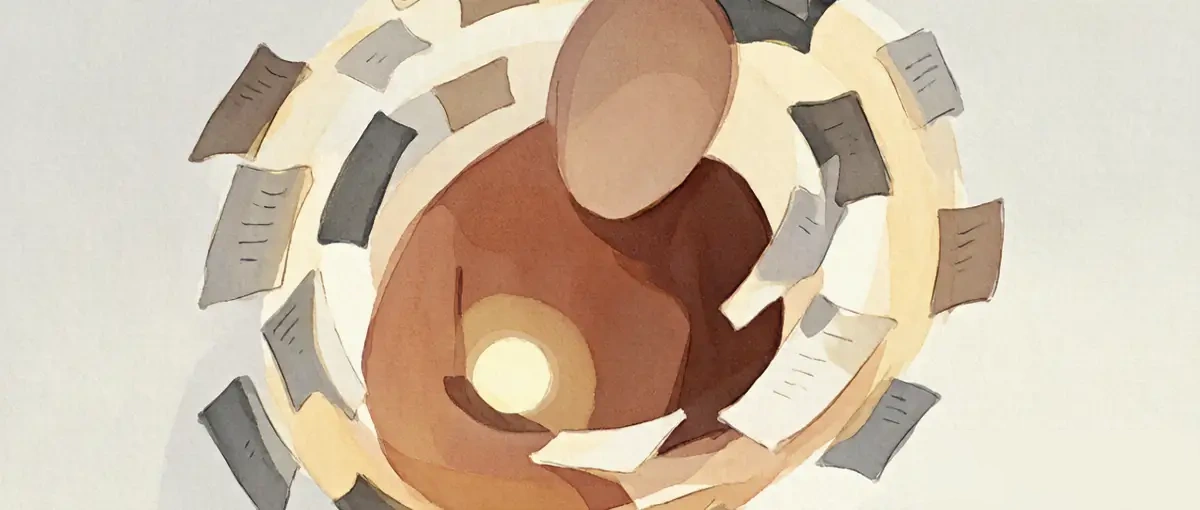
Have you ever had this moment — the moment your hands stop moving, your mind goes empty, and your fingers reach for your phone to scroll through something, anything, as if you need to grab onto something just to feel grounded.
It's not that there's actually work left undone. It's that in that brief opening, a certain unease rises quietly — and you need something else to fill it.
Busyness is the container I found for my unease
I later realized something: the reason I feel most at ease when busy isn't because I enjoy busyness itself. It's because when tasks come one after another and fill my mind completely, I don't have to face myself.
All those things pressed underneath — an awkward reply left hanging, a choice I'm afraid to examine closely, a nameless hollowness — they need space to surface. And busyness is the perfect filler: pack every minute tight and they find no crack to slip through.
So for me busyness was never the goal. It was the method. It solves nothing — it just makes you temporarily unable to see the problems. Like a room owner shoving garbage under the bed — the room looks clean, but the pile keeps growing underneath.
What surfaces in quiet is what I've been hiding from
You tell yourself you're someone who can't sit still, who needs constant motion. But observe carefully: during the day there are meetings, messages, expectations thrown at you from every direction, and you handle them all and everything feels fine. The moment everything goes quiet — weekend afternoons, late nights before sleep, gaps between engagements — that unease starts knocking.
The world isn't too loud. You've been using its noise to drown out something inside. Quiet itself isn't what's frightening. What's frightening is what you might hear once it settles.
Maybe it's a question you've been avoiding. Maybe an emotion you never processed. Maybe just this simple discovery: when you're no longer filled with external things, you have to face a person called "yourself" — and you haven't spent real time with this person in a long while.
"Can't stop" isn't personality — it's unpracticed
Many people label themselves: "I'm just this way, can't sit still," "anxious when nothing's happening." But look closer: behind that restlessness stands a small fear — the fear of being alone with yourself without any task to hide behind.
This isn't a character flaw. It's a skill gap — like someone who never learned to swim panics the moment they hit water. "Simply existing" is something you've never seriously practiced.
From childhood we were trained to "do something," "produce something," "don't waste." Nobody taught us "doing nothing is fine," "emptiness has value." So as adults when free time arrives we're like people who've lost gravity — floating with no idea where to land.
How do I stop feeling safe only when I am busy?
Do not demand a whole quiet weekend from yourself. Begin with ten minutes without tasks, messages, or background input, and notice what rises without rushing to fill it. A small, repeatable pause helps your nervous system discover that quiet is a state you can visit, not a threat you must outrun.
Why does being busy make me feel calmer?
Tasks give your attention a container and keep uncomfortable thoughts out of view. The relief is real, but it may be coming from distraction rather than safety. Build another container slowly—a walk, a shower, or a quiet cup of tea—so calm is not dependent on staying overloaded.
Want to understand what busyness is helping you avoid?
If every empty space fills with unease, gentle self-exploration can help you meet what appears there without turning it into another task.
Leave a crack between busy and stopped
Don't force yourself to go flat and do nothing immediately. Start with ten minutes a day:
No phone. No messages. No tasks. No audio input. Just sit there — by the window, on the couch — let your body experience the state of having zero external input.
At first you'll panic. You'll reach for your phone. You'll try to find something to fill those ten minutes. These reactions are normal — your nervous system has grown accustomed to using "having things to do" as proof of existence. Do it a few more times and you'll discover: quiet isn't as terrifying as imagined. It simply places gently before you the thing you've been hiding from, waiting until you finally have space to look at it.
Maybe you'll look and discover: it's not that scary after all. Being with myself isn't that uncomfortable. Maybe I don't have to keep running to confirm I'm still alive.
Keep reading: Why do I feel drained even when I didn't do much · Why do I feel guilty the moment I rest? · Why do I feel more tired after I rest
Written and reviewed by DustEcho Editorial for self-reflection and cultural inquiry—not counseling, medical advice, or a clinical diagnosis.
Not sure where to begin?