Why Do I Feel Responsible for Everything at Work?
DustEcho Editorial
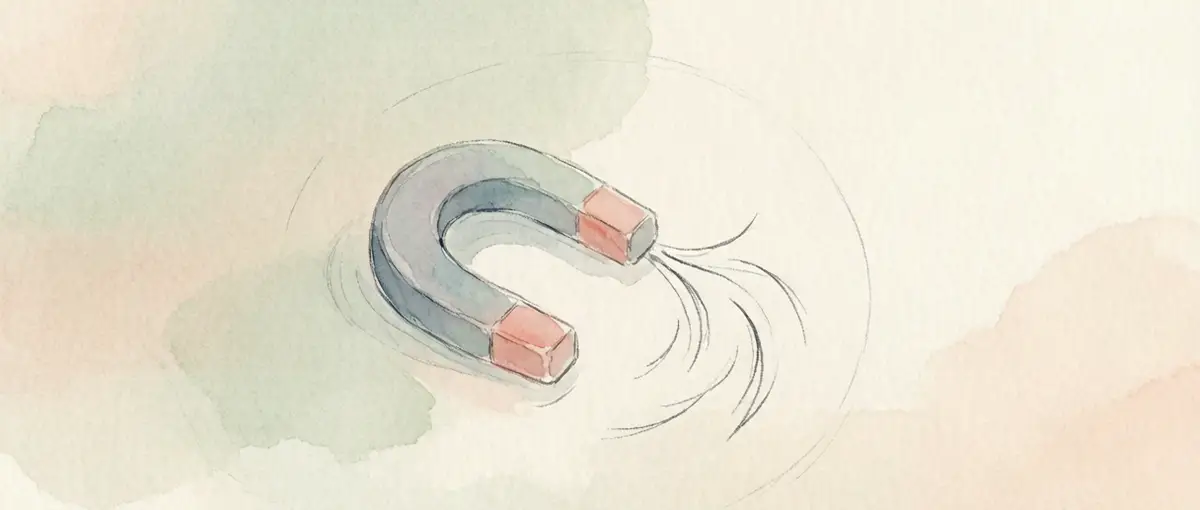
You feel responsible for everything at work because your attention has been trained to scan the edges of every problem and pull it toward yourself — the way a magnet can't help sweeping in every stray bit of metal within reach. It isn't that you caused most of what goes wrong; it's that you've made yourself the place where every loose end lands. And the cost shows up quietly: you're tired in a way rest doesn't fix, because the load you're carrying was never fully yours to begin with.
Monday's standup had barely ended when you heard a coworker mutter, "Why is this process stuck again?" You didn't say anything. But the words followed you all day: Did I CC the wrong person in last week's email? Should I have flagged this to him earlier? The snag happened in a step you never touched, yet you felt an invisible pull yank your name onto the "might be at fault" list before anyone else's.
It isn't a one-off. A project ships with a hiccup, and in the retro you're the first to say, "I own this part." Your boss only frowns, and you spend the rest of the day chewing on every sentence that didn't come out smooth. You start to wonder if you were simply built to carry more than others — or if you were never taught how to push things back out. You're not alone. In the workplace conversations I've had, "over-responsibility" is one of the most common words people reach for. It skips no rank: interns and directors both get caught. The only difference is that some can laugh it off after, while others are barely holding on by the next morning.
Why Do I Take Other People's Mistakes as My Own?
The root is usually that you've fused two different things: "I had some influence over the outcome" and "I am fully accountable for the outcome." Teamwork is a web — when you change one line of code, someone else's test might break; when you reply to a message late, the downstream schedule slips. But "I was involved" is not the same as "it's all my fault," and it's certainly not the same as "I should write the post-mortem."
When someone spends a long stretch in an environment where they're expected to cover for others, the brain builds an over-sensitive scanning habit. It stops carefully separating "where was I" from "where did it go wrong," and instead drops every snag on its own doorstep first. This is often two sides of the same coin as the need for control described in why I can't let go of control at work: one is afraid to hand things off, the other can't put them down. It's shaped a lot like why I feel responsible for other people's emotions too — when you treat someone else's state as your own KPI, the first reflex at any ripple is to apologize.
The harder-to-see part is that you've tied your worth to how much you can catch. Once your value hangs on your ability to absorb problems, of course you'll sweep up everything within reach, unable to tell where the boundary is. You become, in effect, a magnet for other people's slips — pulling them in before they've even landed.
A concrete case: you ran an event that went off without a hitch. The one small slip was that your partner forgot to send the reminder. Yet in the wrap-up you wrote, "My coordination was off." Your partner tried to say, "That was my miss," and you waved it away: "No, I should've been on top of it." See? Even a mistake someone else has clearly claimed, you pull onto yourself by reflex.
Where Does This "It's All My Fault" Feeling Come From?
It usually didn't start at work. If, as a child, the mood at home depended on some adult's temper, you'd instinctively think, "Did I do something wrong again?" That equation — trouble means I'm to blame — gets written into the body early. Work just swaps in a new setting and keeps running the same sum.
Some workplaces reinforce it. When rewards and punishments are murky, the one who confesses first looks dutiful, and the one who stays quiet looks like they're dodging. So you learn to buy a little safety by saying, "I'll take it." But the safety is borrowed — every time you carry a pot that isn't yours, the next time it's harder to tell which ones are genuinely yours.
For others, it's only when they're "needed" that they feel they have any value at all. That drive is the same current as why I only feel safe when I'm busy: the moment you stop and the pots in your hands empty out, you panic instead. The magnet doesn't rest; it keeps scanning for the next thing to pull in, because an empty hand feels like proof you don't matter.
How Do I Tell Which Things Are Actually My Responsibility?
Separating "my responsibility" from "just related to me" is the first step to setting this load down. Before you open your mouth to take the blame, run it past this table:
| Dimension | Truly my responsibility | Only related to me |
|---|---|---|
| Decision | I made the call | I only executed or was informed |
| Information | I should have and could have caught it | Beyond my line of sight |
| Remedy | I can and should act | The person involved should act |
| Consequence | Directly caused by me | A result of the system or others |
The right column isn't telling you to be cold. It's a reminder that caring and carrying the blame are two different things. You can care about how a project goes without writing a self-criticism for every deviation. Concern is collaboration; confession is overstepping to cover.
One reader told me her method: before, at the first sign of trouble she'd fire off a string of "my fault, my fault." Now she forces herself to start with one sentence — "Let me sort out the cause and effect first." That single buffer flips her out of "apologize mode" and back into "analyze mode." A few months later she was carrying less than half the blame she used to, and her colleagues actually found her steadier.
In practice:
- Move the subject from "I" back to "the thing": ask "whose decision was this?" instead of "where did I fall short?"
- Split the retro into three columns: mine, the process's, and someone else's — listed apart, not mushed together.
- Say "what I'm watching is…" not "it's my fault": watching is collaboration; confessing is overstepping to cover.
- Set a blame budget: allow yourself one bout of guilt a day for something genuinely yours; anything beyond that, write it down — by tomorrow it's usually lighter.
You'll find in why I feel guilty when I rest that even "not carrying the blame" can trip the guilt. That tells you how deep the equation runs — but deep-running doesn't mean unchangeable. Starting with one small "this isn't mine," a boundary slowly grows, and the magnet finally learns to let some metal lie where it fell.
Carrying the whole team's blame won't make you more reliable. It'll just make you collapse first. Real reliability is knowing where you're supposed to stand and what you're meant to catch — and handing the rest back to whoever it belongs to.
How do I stop feeling responsible for everything at work?
Separate influence from ownership. Ask: Did I make the decision, control the information, and have a reasonable chance to change the outcome? If not, you may be involved without being fully responsible. Name your part clearly, then leave the rest with the person, process, or team that owns it.
What can I say when I start blaming myself for a team problem?
Try, "Let me separate my part from the rest before I take responsibility." Then sort the problem into three columns: mine, the process's, and someone else's. This creates a pause between noticing a problem and volunteering to carry all of it.
Want to understand your over-responsibility pattern?
If being dependable has turned into carrying every loose end, a gentle self-check can help you tell care from over-functioning. Explore the pattern.
Written and reviewed by DustEcho Editorial for self-reflection and cultural inquiry—not counseling, medical advice, or a clinical diagnosis.
Not sure where to begin?