Why do I still check my phone for work on days off
DustEcho Editorial
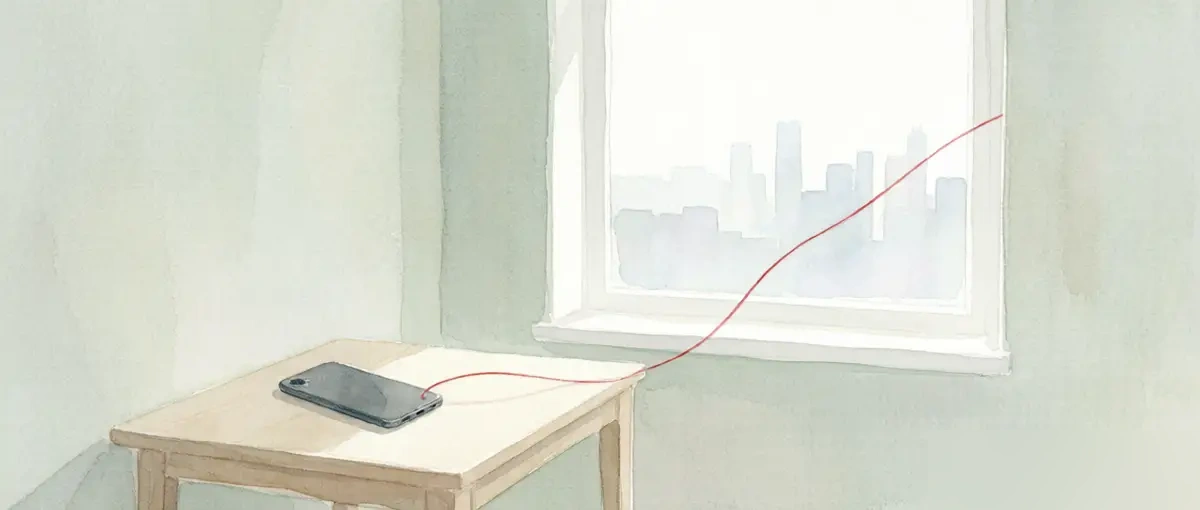
On a day off you meant to slow down, yet your hand reaches for the phone first. Screen lights up, you slide into the work group, check if anyone tagged you, any new email. No messages — you exhale. A few — your heart sinks, but you read each one anyway.
You don't actually want to work. You're just afraid — afraid of facing a pile of unhandled mess Monday, afraid of missing something that puts you on the back foot. That "just one look, it's fine" thought tethers you to the desk, and even your rest carries an invisible string.
"Just one look" — then the morning's gone
You tell yourself just one look. But after that look, your brain clocks in: how should I reply to this, should I draft a plan for that. The morning that was yours gets quietly dragged back to the work channel. Your body's on the couch, but your nerves are already at the office.
This isn't diligence; it's the inertia of not being able to stop. As long as the string's attached, you can't really leave. You think you're resting, but you've only parked your body elsewhere while your attention stays pinned to that lit screen.
Not wanting work — afraid it'll be worse later
What really pulls you isn't passion for the job; it's anxiety about the "backlog." You picture Monday's inglorious moment opening the laptop, so you'd rather defuse the bomb now than get blown up then. But defuse one and another appears — the string's end keeps spawning new things.
You trade "handling it early" for a moment's peace, at the cost of never-complete rest. The twistier part: the more you defuse early, the more "good thing I checked" you feel, so next time you trust it even less — that string gets tightened again and again by your own "effectiveness."
The phone became a second heartbeat
Somewhere along the line, a phone buzz gets your fastest reaction of all. It's no longer just a tool; it's the pulse between you and the workplace. Even on silent, you'll open it yourself every few minutes, like confirming it's still alive, that you haven't been left behind.
The cruelest thing about this string is it makes you think you're in control, when really you've been led the whole time. The more often you check, the more "I can't not check" you feel. But the truth is, most of what you find doesn't get lighter for being seen early — it just pre-occupies time that should have been blank.
How do I stop checking work messages on my days off?
Set a defined offline window, mute work channels, and agree on what counts as a real emergency and how it will reach you. Before going offline, write the next workday's first action so your brain does not need the phone as a reminder. Rest becomes real when your attention is allowed to leave too.
What if I miss something important while I am offline?
Use a clear escalation rule rather than continuous monitoring. If something truly cannot wait, a direct call or agreed contact route can reach you; ordinary group-chat updates can wait. Checking every message is not the same as being prepared, and it often transfers Monday's anxiety into your day off.
Want to understand why switching off feels unsafe?
If your hand reaches for work before you have noticed the urge, gentle self-exploration can help you loosen the always-on habit without abandoning responsibility.
Try cutting that string for a day
No need to sever all contact at once. Start with half a day: mute the work groups, put the phone in another room, tell yourself "for these hours, even if the sky falls it waits till I get up." You'll find the world doesn't collapse because you vanished for half a day.
Rest has to actually "go offline" before the body remembers what loosening feels like. That string isn't something you shouldn't have — just don't let it stay taut twenty-four hours. You deserve a stretch of time that's whole, not yanked away by a screen — not to work harder, but because the person you are was never really there.
A real emergency will break the door down to find you
Most of what you fear "missing" doesn't need weekend handling at all. A genuinely urgent fire will get a phone call, a direct reach-out — not a quiet group-chat note left for you to find Monday.
You've treated "always on standby" as insurance, but what it covers is almost all stuff that could've waited. The truly urgent was never dependent on you staring at a screen to be noticed.
Keep reading: Why do I feel like I have to earn my rest? · Why Do I Feel Like I Never Recover · Why do I feel relieved when a meeting is cancelled
Written and reviewed by DustEcho Editorial for self-reflection and cultural inquiry—not counseling, medical advice, or a clinical diagnosis.
Not sure where to begin?