Why Do I Always Feel Behind in Life
DustEcho Editorial
Someone in the group chat posted a new flat. A friend changed their title. A cousin two years younger than you is apparently settled too. You liked the post with a smile, locked the phone, and the moment the room went quiet, something pressed lightly on your chest.
It's not envy. You're genuinely happy for them. But the thought "am I behind?" arrives faster than the happiness, and stays longer.
Why do I always feel behind in life?
The feeling often comes from comparing your in-between with someone else's arrival. Their visible milestone is not a fair measure of your starting point, resources, timing, or quiet progress. Explore the pattern gently if another person's good news immediately becomes evidence that you are late.
They moved ahead again, and your chest tightens
This feeling is sneaky. It rarely shows up when you've actually stumbled. It jumps out when others are doing well. You were walking your own track just fine — the second you see someone else's "progress," your feet sink into mud.
You assume you haven't tried hard enough. But look back: this year you moved too. The steps you took just don't photograph well — you survived an urge to give up, you repaired a relationship, you finally said no to something you didn't want. None of that shows up in a nice picture, so it doesn't light up the way "other people's progress" does.
You're comparing their "arrival" to your "in-between"
What we put side by side is rigged from the start. Others show results: bought a place, got promoted, got married. What you hold is the process: still saving, still unsure, still don't know what you want.
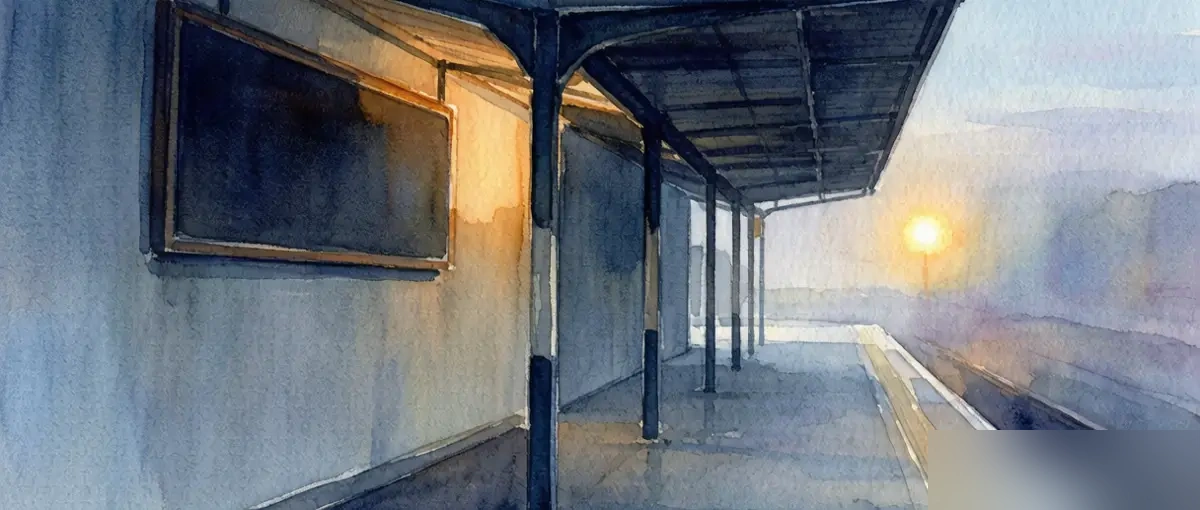
It's like standing on a platform, staring at the board. Everyone else's line reads "arrived." Yours sits at "waiting." So you decide you missed your train. But you can't see that nobody bought the same ticket, and nobody started at the same station. You measure your "still on the way" against their "already there" — and the gap you feel isn't real.
That "finish line" was never drawn
"Behind" only means something if there's a line everyone agrees on. Life has no such line. What you "should" have at thirty, what you "should" own at thirty-five — those marks were written on the wall by other people, not signed by you before you set out.
Some know their direction at twenty and settle at forty. Some loop around and the step that brings them back is the steadiest one. The progress bar was never one length, never one starting point. You measure yourself with a ruler that doesn't exist, and "not enough" is the only reading it gives.
Behind is not a fact, it's a viewpoint
Saying "I'm behind" really means "I'm holding myself to someone else's script." In that script life is a straight line, first to arrive wins. But real life is more like separate roads — some take the highway, some the mountain path, some step off to watch the view for a long while.
The "slow" you feel is often not your pace. It's you walking while twisting back to check where everyone else is. Head turned backward, feet hesitate. That lump in your throat isn't from truly lacking. It's from using someone else's timetable as your own.
First, put down the clock that tells someone else's time
You can't chase this feeling away by "trying harder," because it was never a hole effort could fill. The station you catch up to is always one someone else defined — finish one, and the next appears.
What you can do is set that clock down for a while. Not to give up, but to free your eyes to see the road under your own feet: compared to last month, do you know more clearly what you don't want? That's moving too. You don't need to be in anyone's frame. You only need to confirm — you're still walking, in your own direction.
The moment the feeling loosens is rarely when you've passed someone. It's when you finally stop staring at the screen that shows someone else's schedule. The platform is the same platform, but you can turn and walk toward the platform you actually mean to reach.
Keep reading: Why do I feel guilty for taking up space? · Why do I feel I don't deserve good things · Why do I measure my worth by what I produce
Written and reviewed by DustEcho Editorial for self-reflection and cultural inquiry—not counseling, medical advice, or a clinical diagnosis.
Not sure where to begin?