Why do I say sorry even when I've done nothing wrong
DustEcho Editorial
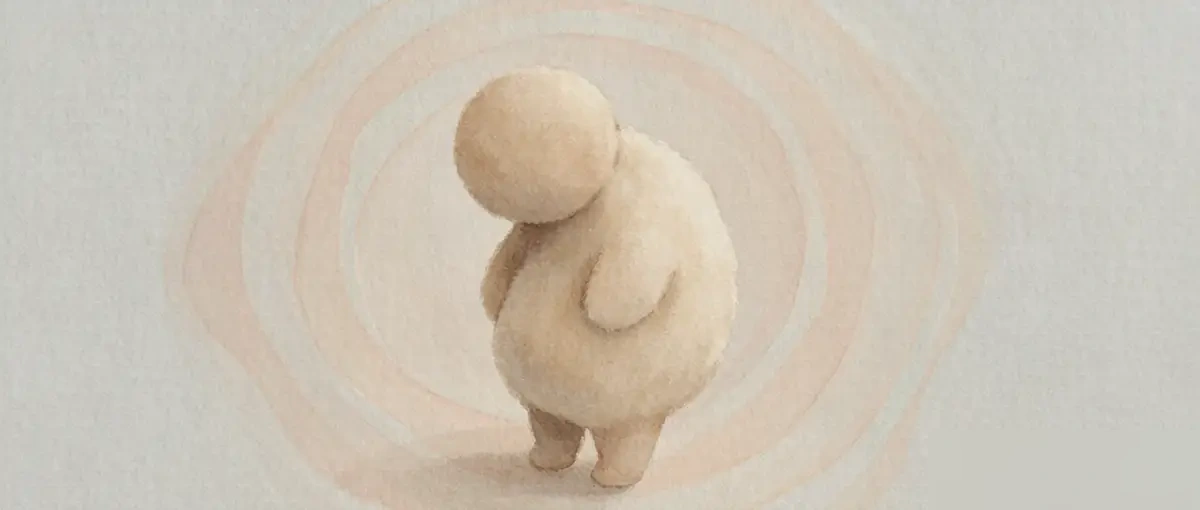
A colleague brushed past and bumped my desk. "Sorry!" I said without thinking. They paused — "I bumped into you." Only then did I realize: here we go again. It wasn't my fault, but "sorry" was faster than my brain.
This isn't the first time. Think through your day — how often does "sorry" or "my bad" slip out of your mouth? Someone gets slightly too close to your space. Your voice rises a fraction too loud. Even someone walks past you and you're not sure whether you were in the way — your mouth is already apologizing on your behalf.
"Sorry" became my default language
I spent some time consciously observing myself, and I noticed a pattern that genuinely unsettled me: whenever I occupied even the tiniest amount of resources — space, attention, time, even someone's imagined convenience — my first instinct was to apologize first.
Not because I actually felt at fault. Because "apologizing first" had become a survival strategy, a preemptive surrender. Its subtext reads: "I know I'm an inconvenience, so let me demonstrate that I'm aware." Like ducking your head when entering any room — regardless of whether it belongs to you, lower yourself first, just in case.
This habit runs so deep that often I'd finish saying "sorry" before realizing: wait, what does this have to do with me?
What I'm afraid of isn't making mistakes — it's that existing itself is wrong
Dig one layer deeper and the underlying logic goes something like this: I feel like my very presence might be an intrusion.
This sounds extreme, and it probably doesn't exist as a clear sentence in your conscious mind. More likely it's a diffuse feeling: I'm not light enough, quiet enough, unobtrusive enough. So I apologize before anyone can express displeasure, snuffing out that "am I in the way?" anxiety before it catches fire.
Saying "sorry" isn't admitting fault — it's buying peace of mind. Proof that "I didn't inconvenience anyone." Except this peace of mind is fake. Because you didn't actually inconvenience anyone. Your apology is just paying a tax to thin air that you never owed.
The more I apologize, the more transparent I become
Here's the hidden cost: the more habitual the apologizer, the thinner their presence becomes.
Think about it — if a colleague says "sorry" constantly, what's your impression? Someone who's always shrinking, always yielding, who feels guilty simply for standing normally. Over time, "sorry" becomes their tag — a person who comes with built-in apology, someone who doesn't need to be taken seriously because they don't take themselves seriously.
What's more dangerous is when a moment arrives where you should stand up for yourself, where you deserve an apology — you've lost the ability. You're so used to finding excuses for others, rationalizing away their behavior, swallowing your own grievance and saying "it's fine, really." It's not that you can't get angry — it's that you've convinced yourself you don't have the right to.
How do I stop saying sorry when I did nothing wrong?
Pause for one second and ask whether you caused harm or are simply occupying normal space. If it is not yours to repair, replace "sorry" with "thank you," a factual statement, or nothing at all. An apology should repair an impact, not erase your ordinary presence.
What can I say instead of sorry?
Try "thanks for waiting," "excuse me," or "I appreciate the help," depending on what actually happened. If someone bumped into you, you can simply make room and continue. Matching the words to the facts helps your boundary and your self-respect stay in the same room.
Want to understand why existing feels like an inconvenience?
If you apologize before anyone has asked you to, gentle self-exploration can help you take up ordinary space without turning it into a debt.
Replace "sorry" with something else
Here's an exercise I tried that worked better than expected: every time your mouth wants to say "sorry," force yourself to pause for exactly one second.
In that second, ask: whose territory is this? If it's their mistake — they bumped into you — then you don't need to apologize. If you're simply doing a normal thing in a normal way — walking down the street, sitting in a chair, expressing an opinion — then you don't need to apologize for the fact of that thing existing.
Then try replacing it. Swap "sorry" for "thank you," or say nothing at all and offer a normal smile instead.
It will feel deeply awkward at first. The word will sit in your throat, refused exit, and your hands won't know where to go. But gradually you'll discover: when you don't apologize, the sky doesn't fall. Nobody dislikes you for omitting "sorry." Most people don't even notice you didn't say it — because from the start, they didn't think there was anything to apologize for.
You don't need to apologize for taking up space. This world has room for you, including your ordinary sounds and movements.
Keep reading: Why do I feel I don't deserve good things · Why Do I Always Feel Behind in Life · Why do I measure my worth by what I produce
Written and reviewed by DustEcho Editorial for self-reflection and cultural inquiry—not counseling, medical advice, or a clinical diagnosis.
Not sure where to begin?