Why do I make my rest into another job
DustEcho Editorial
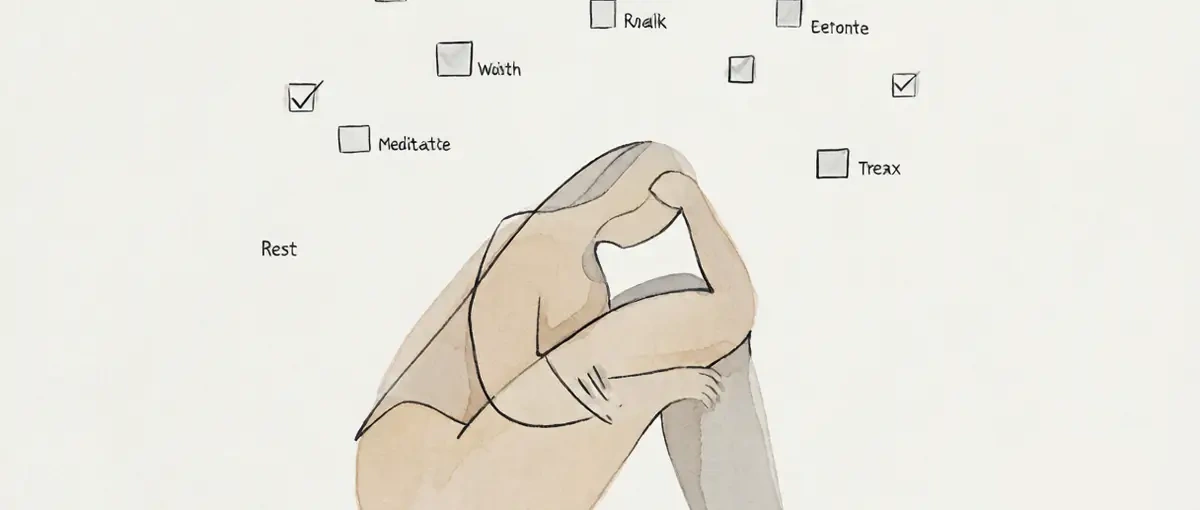
You made yourself a "relaxation schedule" for the weekend: yoga in the morning, reading in the afternoon, meditation at night, plus "quality time with family" squeezed in between. You mentally check off each item like you're managing a project, treating rest with the same seriousness you bring to work. By Sunday evening you discover something absurd: you're more tired than after a workday.
You wanted to rest. How did you turn rest into another job?
Even "doing nothing" needs to prove its usefulness first
The most ironic part is this: you don't not know how to rest — you can't permit yourself to rest without purpose.
Binge-watching shows? Wasting time. Staring into space? Frittering life away. Lying there thinking nothing? Absolutely not — even rest must produce results, carry meaning, have measurable outcomes. Either you're "improving yourself," or "recovering energy so you can work better," or "nurturing relationships." In short, every minute needs a label.
Have you noticed this logic is nearly identical to the one you use at work? Efficiency, KPIs, ROI — just a different desk. Your body lies down but the examiner in your head stays standing, holding a clipboard: was today's rest quality acceptable? Did I do yoga? Read? Meditate with focus? Miss one item and the anxiety starts: failed to rest properly again.
I welded "task mode" onto my nervous system
This isn't about diligence or laziness. It's that your nervous system has grown too accustomed to the state of "must always be doing something."
Think back: when was the last time you genuinely rested — not "planned relaxation activities" but that sudden, unscripted moment of thinking absolutely nothing? Maybe an afternoon staring at leaves outside your window until you lost track of time. Maybe a shower when your mind went blank for a while. Maybe walking home when your steps slowed and you weren't rushing toward anything.
Does that feeling seem foreign? Even slightly uncomfortable? Because when your brain actually stops, you encounter things that busyness usually keeps at bay — emotions you haven't processed, problems you haven't faced, that thing you keep postponing to "when I have time."
So rather than face all that, "might as well find something to do" becomes your most familiar form of avoidance. Even rest becomes a way to avoid resting itself.
Real rest doesn't need a checklist
Here's something counterintuitive: the highest-quality rest often happens in moments you never planned at all.
Not "3–4 PM: reading time" written on your calendar. But during that slot you meant to read, opened page one, got drowsy, and accidentally napped for twenty minutes. When you woke up sunlight fell right on your hand. You stared at it for a moment, then decided to stay lying there — abandoning every plan and letting this afternoon slip through your fingers.
This kind of "uncontrolled" rest is real rest. Because your nervous system finally received the signal: no instructions to execute right now. Can shut down. Can stop existing. Can simply be a person lying there, accountable to no one, responsible for nothing.
And those "high-quality rest activities" on your checklist? They're still tasks underneath. The task content just changed to "relaxing."
How do I stop turning rest into another job?
Leave one block unnamed. Do not give it a checklist, outcome, or recovery score; let yourself nap, wander, read, or change your mind. The point is not to optimize the time but to let your body receive a clear signal that nothing needs to be produced right now.
Why does even relaxing make me feel pressured?
When task mode has become your default, you measure rest by usefulness and miss the relief of being unaccountable for a while. A relaxation checklist can reproduce the same pressure as work. Try one flexible invitation instead of a plan, and stop when the time feels complete rather than when every item is checked.
Want to understand why rest turns into performance?
If recovery has become another way to prove that you are doing life correctly, gentle self-exploration can help you set down the clipboard.
Try keeping a block of "useless" time
If letting go completely feels impossible, start small: deliberately leave an unnamed block on your calendar or weekend plan. Don't write "free time" (that's another item). Don't write "mindfulness" (that's another goal). Just leave it blank. Thirty minutes, an hour — whatever. During this time you may do something or nothing at all. Space out. Pick up your phone then put it down again. Study the pattern on the ceiling. Sit by the window and watch people pass below.
The point isn't what you get from this time. It's that during it, you aren't required to give anything.
This might be the closest you get to genuine rest all week. Not because these moments have any special healing power, but because in them, finally, nobody (including you) is collecting homework.
Keep reading: Why do I keep counting the hours till quitting time · Why Do I Feel Like I Never Recover · Why do I feel relieved when a meeting is cancelled
Written and reviewed by DustEcho Editorial for self-reflection and cultural inquiry—not counseling, medical advice, or a clinical diagnosis.
Not sure where to begin?