Why Do I Keep People at a Distance Even When Lonely?
DustEcho Editorial
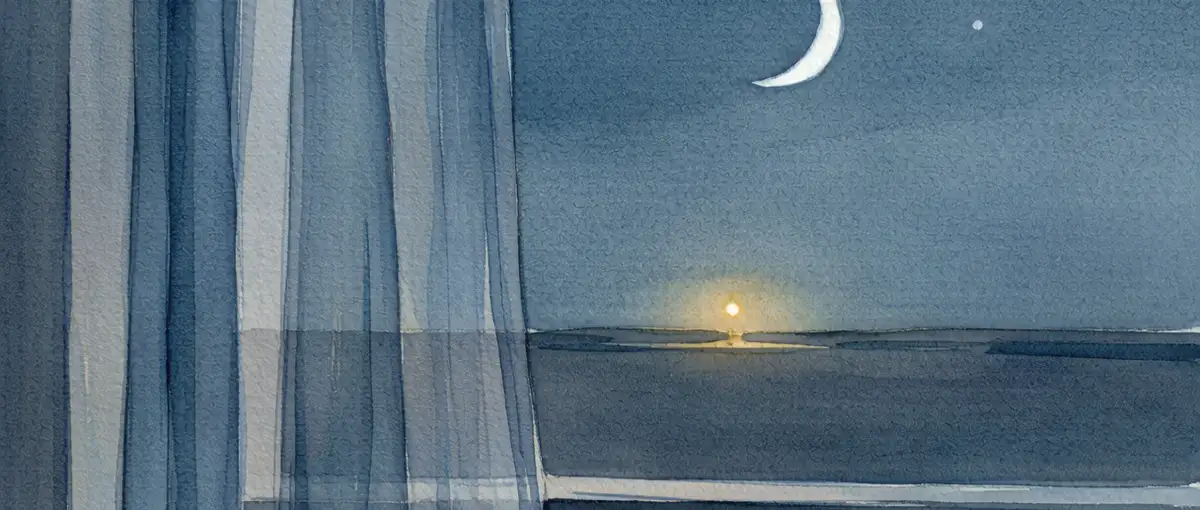
Yes, this is completely normal — and it is almost never "you don't need people." Pushing people away while feeling lonely usually means your body has learned to read "being approached" as "I might get swallowed, seen through, or let down." So between the pain of loneliness and the fear of closeness, you instinctively flinch away from the one that feels more alarming. In other words, the people you push away are often exactly the ones you secretly wish would stay.
A familiar scene: late at night you scroll past photos of friends at a gathering, and something in you goes hollow. Your thumb hovers over the text box; you almost type "I miss you all." But in the end you just tap the like button and flip the phone face down. Not because you didn't want to say it — but because before the words form, another sentence arrives first: "What's the point, they won't really get it." The room goes quiet, the light stays on, and you bolt the door from the inside again.
Why do I push people away exactly when I'm lonely?
It sounds like a contradiction, but neurologically it makes sense. Loneliness amplifies your sensitivity to "relationship threats," and closeness means exposure. When someone has been hurt in relationships before — ignored, judged, suddenly withdrawn from — their nervous system quietly wires "intimacy" to "danger." The result: the lonelier you are, the louder the alarm; the louder the alarm, the less you dare to open the door.
This is the same mechanism behind the reaction of wanting to flee the moment someone gets near. Many people shrink back the instant closeness appears, not because they don't care, but because the body has already shifted into defense, as covered in why I pull away when someone gets close. You think you're cold, but really you've misread "approach" as "the prelude to losing control."
There's an overlooked point: when you're lonely, self-esteem tends to drop. The emptier you feel, the more you fear others seeing that emptiness, so you hide behind distance. But the thicker the distance, the less anyone can get in, and the more your emptiness gets confirmed — a closed loop.
What is this "pushing away" actually protecting me from?
If you ask the body "what are you guarding," it usually can't answer, because what it's guarding is an old ledger from long ago. Spread out the unspoken defenses and they look roughly like this:
- Fear of being seen through: You worry that if someone gets close, they'll see the self you're dissatisfied with, and leave.
- Fear of owing a debt: Being cared for means "I'll have to repay later," and you can't repay it — so you'd rather not take the kindness.
- Fear of losing control: Get too close and your emotions are no longer only yours to manage; you can't stand that suspended feeling.
- Fear of being abandoned again: Better to step back quietly now than be thrown away later.
Of these four, the first two are the most common, and both circle back to the same root: "Do I deserve to be treated this way?" When someone deep down feels they don't deserve good things, another person's kindness makes them uneasy; and that fluster when receiving goodwill is often not politeness but panic — "if I catch this, I'm admitting I need you," as explored in why receiving kindness feels awkward.
Laid out as a table, you can see more clearly the two voices running at once inside you:
| When I want to reach out | What I'm actually afraid of | What my body does |
|---|---|---|
| Want to message an old friend | Afraid it looks needy, afraid of being left on read | Delete the words, just tap like |
| Someone cares unprompted | Afraid of owing, afraid they want something | Polite distance, change the subject |
| Lonely to the point of hurting | Afraid admitting "I need people" means defeat | Throw myself into work, pretend fine |
Every "fear" in those cells isn't "I don't want you" — it's "I don't yet dare believe you'll stay."
Notice, too, that none of these fears are really about the other person. They're about a story you've been telling yourself for years — that closeness costs more than it gives, and that the safest move is to stay behind the wall. The wall kept you safe once. The real question now isn't whether to tear it down, but whether you're ready to leave the window open a crack. A crack is not a collapse; it's just enough light for someone to find you.
Is this some kind of character flaw?
Of course not. It's a self-protection that was useful once, and simply hasn't updated since the environment changed. If expressing a need as a child brought only neglect or mockery, the brain's optimal strategy became "don't expect, then you won't be disappointed." That strategy got you through those days; it saved you. It's just outdated now — like a winter coat you're still wearing in summer. It's hot, sure, but that's not the coat's fault.
So don't rush to call yourself "difficult" or "messy." The first useful step is swapping the harshness toward yourself for a little compassion: see that you're protecting yourself, not sabotaging the relationship. Only when you can say to that "door-bolter," "I know you're doing this for me," does the door begin to loosen.
Why is there a whole stretch of road between "needing people" and "trusting people"?
This is the easiest place to get dizzy. You may have already admitted "I really do need connection" — but admission or not, the door stays shut, because "needing" is cognition and "trusting" is body memory. They aren't one line; they're two different things. Cognition can turn on a dime; the body needs to be treated safely, again and again, before it slowly dares to trust.
This is also why many would rather carry it alone: carrying it yourself is at least predictable; handing it to someone adds variables, discussed in why I'd rather carry it alone. And the moment someone is too good, it triggers another alarm — "what do they want, why be this kind to me?" as in why I get suspicious when loved. Both show you're not rejecting relationship; you're waiting for evidence that "they won't suddenly vanish."
To shorten that road, you don't have to throw the door open at once. Start tiny:
- Next time you're lonely, don't delete that sentence — send even half of it, like "I've been wanting to talk to someone lately."
- When someone is good to you, you don't have to repay immediately; let yourself say "thank you, that warmed me."
- Quietly rewrite "I don't need people" as "I'm not ready to let anyone get too close yet" — the first is a verdict, the second is a state.
None of this is a big leap outward. It's just loosening one of the bolts on the door.
The light staying on in the room is itself already a signal — it says "I'm still here, I'm just a little afraid." You don't have to throw the door wide open, and you don't have to pretend you're not lonely. Real closeness was never about who rushes in first; it's one person willing to stand a while longer at the door, and the other finally daring to flick the top bolt loose.
How do I stop keeping people at a distance when I'm lonely?
Choose one small act of contact that does not require you to reveal everything: send, "I've been wanting to talk — are you free this week?" Then let the other person respond without deciding in advance that they will disappoint you. Connection can begin as a small opening, not an all-or-nothing surrender.
Why do I push people away when I actually want them close?
Distance can feel safer than the uncertainty of being known. It gives you control, but it also confirms the loneliness you are trying to escape. When the urge to withdraw appears, ask whether you need real space or a slower pace, and communicate that difference plainly.
Want to understand your fear of closeness?
If loneliness and self-protection keep pulling in opposite directions, gentle self-exploration can help you loosen the pattern without blaming yourself for having it.
Written and reviewed by DustEcho Editorial for self-reflection and cultural inquiry—not counseling, medical advice, or a clinical diagnosis.
Not sure where to begin?