Why Do I Always Fear Making Mistakes
DustEcho Editorial
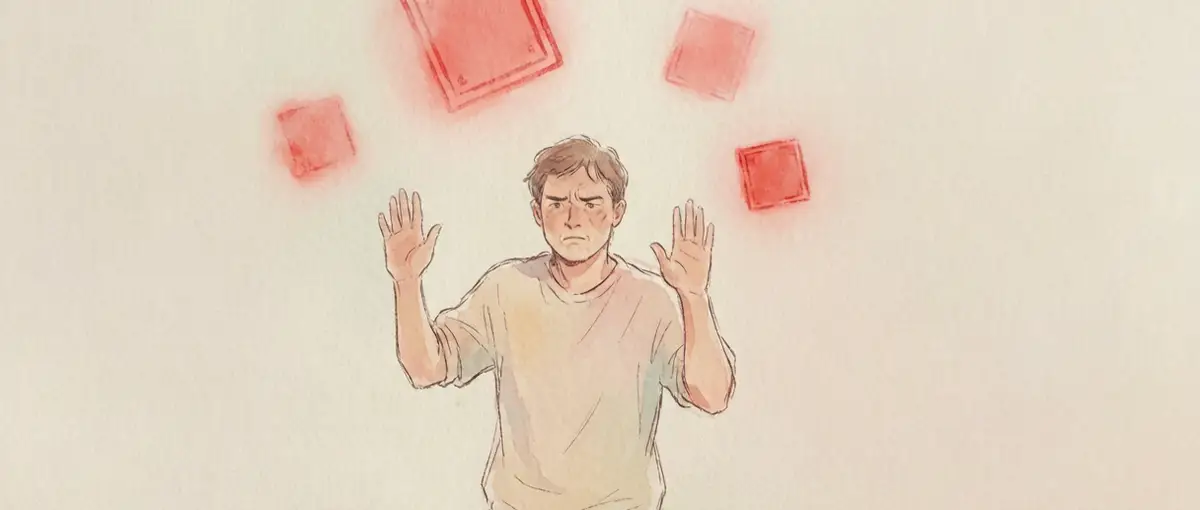
You send an ordinary email, yet you check the wording three times, and after hitting send you still stare at the screen wondering "was that last line impolite?" A decision at work that doesn't even matter, and you can agonize all day — not because you lack an opinion, but for fear of "what if I chose wrong?" Even giving a friend advice, you preface it with a pile of "I might not be right," as if without saying so, any error would be entirely your fault.
It's not that your ability is low. It's that tightness of "can't afford to be wrong," like a string pulled taut too long, trembling at the slightest touch.
"What if I'm wrong" — the rehearsal in your head
People who fear error often run the same play in their heads: before anything happens, you've already acted out every way it could go wrong. The plan gets rejected, the words get misunderstood, the decision turns out badly — in every version, the ending is "it's all my fault."
This play is exhausting. It drags you down with imaginary failure before you've even done the real thing. So many tasks aren't impossible — they're quietly set down by you, worn out by the tug of "could it be wrong?"
Worse, you apologize in advance for "maybe being wrong." Before you start, you say "I might mess up"; before you've erred, you've already pinned yourself in the sinner's seat. As if confessing first makes the error hurt less — but most of the time, you won't err at all.
How "wrong" became a verdict on "me"
For many people, being wrong was treated severely in childhood. Spilling a cup drew "why are you so careless"; a bad grade brought "you just don't try"; a wrong word got corrected in public. Wrong was never just "this thing wasn't done well" — it also proved "you're incapable" and "you disappoint people."
Over time, you welded "doing something wrong" to "I'm bad." As an adult, even a small slip makes your body automatically enter "being judged" mode: heart racing, face burning, wishing you could crawl into a crack. What you fear isn't the error itself, but the conclusion behind it — "see, I really am no good."
There's another layer: when the environment around you allows little error — a harsh boss, a partner who loves to bring up the past — you treat "not erring" as your only source of safety. Better not to act than to risk being wrong.
What it quietly takes away
The most direct is your drive to act. Because you fear error, you keep waiting for the "more certain" moment, but it rarely comes. Others move forward through trial and error while you stay put in preparation. Over time, it's not that you can't — it's that you never gave yourself a chance to play.
It also wears you out in relationships. You don't dare express what you really think, for fear of saying the wrong thing and hurting or annoying someone; you're always gauging "how not to err," living as the most tactful yet most taut person. Those around you find you steady; only you know how much inner churn that steadiness cost.
Deeper still, it keeps you from being yourself. You're afraid to wear what you want in case it's odd, say what you want in case it offends, choose what you want in case you regret it. You live life as a "zero-error exam paper" — the score may be decent, but it isn't you.
Shrink the size of "wrong"
Next time the "what if I'm wrong" thought appears, try pulling it apart: are you afraid of "this thing goes badly," or "if it goes badly, it means I'm lacking"? Most of the time it's the latter. And the latter is an old script, not a fact.
Give yourself an "error allowance": for small things, allow yourself to act off the cuff, no second check; for medium decisions, make a "reversible version" first — send a draft, try it for a week, adjust if wrong, no need to get it perfect in one step. Error was always the starting point of adjustment, not the end.
Also remember this: others aren't watching your mistakes as closely as you imagine. The night you toss and turn over a small slip, the person involved probably forgot long ago. People's tolerance for you is usually far greater than your tolerance for yourself.
In the end
Fearing error isn't a flaw — it's your intention to do things well. Just don't let that intention become the rope that binds you.
What truly grows a person was never "never erring," but slowly finding the path through error. You don't have to be right every time; you can be someone who errs, corrects, and moves forward. Loosen that string a little — things don't break as easily as you fear, and you deserve to live a bit lighter.
How do I stop being so afraid of making mistakes?
Shrink the size of the decision and make the first version reversible. Send a draft, test a small change, or choose a review point instead of demanding certainty before you act. Give yourself an error allowance for ordinary, recoverable mistakes so caution does not become paralysis.
Why do mistakes feel like proof that I am not good enough?
Fear becomes heavier when an outcome is treated as a verdict about identity. A mistake usually tells you what to adjust, not what you are worth. Name the specific result, the lesson, and the next repair; keep the global judgment out of the process.
Want to understand why being wrong feels unsafe?
If every imperfect result turns into self-judgment, gentle self-exploration can help you make room for learning without putting yourself on trial.
Keep reading: Why can't I relax until everything is done? · How to Stop Saying "Sorry" When It Isn't Your Fault · When Work Gets Thrown Your Way, How Do You Stop Automatically Catching It?
Written and reviewed by DustEcho Editorial for self-reflection and cultural inquiry—not counseling, medical advice, or a clinical diagnosis.
Not sure where to begin?