When Work Gets Thrown Your Way, How Do You Stop Automatically Catching It?
DustEcho Editorial
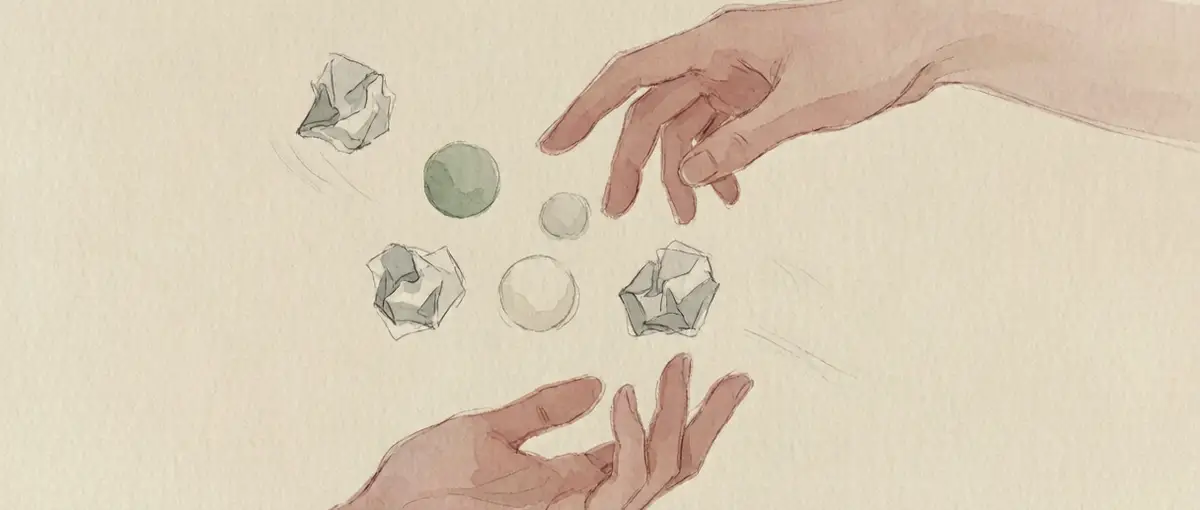
The fix isn't to become the person who never helps. It's to slow down the half-second reflex that makes your hand shoot out the moment a task comes flying. Someone tosses a request at you — "can you take a look?" — and before your brain has asked whether this is even your job, your fingers have already typed "sure." That gap between their throw and your catch is where everything goes wrong, and also where everything can be fixed. You interrupt the automatic reaction by wedging a few seconds of pause into that gap, so the circuit that says yes-by-default loses power for a moment.
This isn't about building a wall. The goal is not to become the person who dodges every ball in the room — that's the opposite extreme, and it turns you into the teammate who hides from work, which is more exhausting and more damaging to your reputation in the long run. What we're talking about is swapping "catch automatically" for "look, then decide whether to catch." The ball is still the ball. You just get one more choice about it. Those few seconds of pause are the freedom itself; they're also the crack that opens between you and the "nice person who says yes to everything" identity. Once the crack appears, light gets in: you start asking, is this actually mine to carry?
The reflex isn't a character flaw. It's a habit your nervous system learned because, for a long time, catching was the path of least resistance. Nobody sat you down and taught you to pause. So the hand moves before the thought does. The good news is that a reflex can be retrained. You don't need a personality transplant; you need a tiny, repeatable interruption — a small habit of stopping for a breath before you answer.
How do I say no without looking like I'm not a team player?
Refusing is not the same as dropping the ball. The most stable way to say no is to replace "I won't do it" with "here's how I'd route this" — acknowledge the need first, then point to the right owner. For example: "I'm slammed right now, but Li just freed up — want me to pull him in?" What you're declining is doing it yourself, not solving the problem. This is close to what we explore in why do I over-explain when I say no: you don't have to atone for a refusal with a paragraph of justification. One sentence that hands over an alternative is enough.
Real non-cooperation looks like sulking, going silent, or letting the task rot in the middle of the floor. Clearly saying "this belongs with X, let me connect you" actually moves things forward. What people remember isn't "he wouldn't help" — it's "he knows who to go to." That's a reputation worth more than being the person who absorbs everything, because it shows judgment rather than mere willingness.
What if the other person gets upset after I refuse?
First, separate the two possibilities: is their annoyance because the work is genuinely stuck, or because the expectation that you'd catch it for them just got broken? Most of the time it's the second. As we covered in why do I only set boundaries when I'm angry, many people never draw a line until they're furious, so others default to treating them as an infinite-capacity container; the moment you close the lid, of course they're uncomfortable. That discomfort usually passes — provided you don't quietly pick the work back up out of guilt. And if guilt is the part that gets you, why do I feel guilty after setting a boundary goes deeper on where that guilt actually comes from and why it isn't a reliable signal.
If they're genuinely blocked, that still isn't your fault — it's a division-of-labor problem that should be fixed at the root. You can point the way without walking the whole distance for them.
Some people worry: if I say no now, will they say no to me later when I need help? In a healthy relationship, mutual refusal is normal, not a debt. You say "this goes to Li" today; tomorrow when you genuinely need a hand, they'll likely respond normally — because what you're running is long-term collaboration, not a ledger of personal favors. Reading one refusal as "the relationship is broken" is using a magnifying glass to study a sesame seed.
I already said yes — how do I hand the work back instead of quietly grinding through it?
If the ball is already in your hands, don't white-knuckle it to the final minute. Two moves help. First, shift from "I'll just do it" to "who does this actually belong to," and gently return it to its lane in the group chat or the meeting. Second, if part of it genuinely is yours, clearly cut off the slice that exceeds your share. The table below is a quick way to sort it out:
| Where the task lands | What you do |
|---|---|
| Always someone else's work; you only caught it out of softness | Hand it back with a short progress hand-off |
| Meant to be shared, but you absorbed all of it | Keep your share, return the rest |
| Truly yours, but you could get help | Ask for a hand; don't carry it alone |
The most hidden cost of catching work on autopilot is that it steals your chance to practice saying no. Every time you carry something for someone else, you reinforce the story "this can't happen without me"; every time you return it to its rightful owner, you train the team to grow its own muscle. You're not dumping the responsibility — you're giving it back to its real owner.
As why do I hate asking for help at work points out, a lot of people treat asking for help as a sign of weakness, so they'd rather grind alone. But grind to the end and the cost of mistakes and burnout dwarfs the cost of opening your mouth once. The same reflex that makes you catch the ball makes you refuse the lifeline — and both can be interrupted with the same pause.
Why does catching fewer balls let you catch the ones that matter?
At the bottom of it, why do I try to be liked by everyone at work shows how "being needed" gets mistaken for "being valued." When you don't catch the flying ball, the other person may not love you more — but you free up capacity to catch the few that are truly yours and truly important. The first few times you practice not-catching feel awkward, like working a new muscle; push past the awkwardness and the reflex rewires. Next time a ball flies, your hand lags half a beat and your brain speaks first: is this mine?
In the beginning, those few seconds of pause will leave your mouth dry and your heart racing, as if you've offended someone. That's normal — it's the old reflex protesting. Pause a few more times and you'll notice: most flying balls were never meant to land in your arms, and the hands you free up are exactly the ones that can catch what you actually want to do. Refusing isn't an endpoint; it's handing your attention back to yourself. Only when you stop being on-call for everything do you make room for something that's your own.
The takeaways
- The problem isn't your kindness — it's a too-fast reflex. Insert a pause between "they asked" and "you said yes."
- Refusing well means routing the task, not dropping it. One sentence with an alternative beats a paragraph of apology.
- The other person's annoyance is usually just a broken expectation, not a real blockage — and it passes if you don't quietly take the work back.
- Already holding the ball? Return it to its owner or cut your share. You're not shirking; you're restoring ownership.
- Catch fewer balls so you can catch the ones that matter. The pause is the freedom; the crack is where the light gets in.
How do I stop automatically taking on other people's work?
Before you say yes, ask who owns the task, when it is needed, and what would have to move if you took it on. Then state your capacity plainly: "I can't own this by that deadline, but I can review the first draft on Thursday." A specific limit interrupts the automatic yes without abandoning the team.
How do I say no without feeling guilty at work?
Treat guilt as a feeling to carry, not proof that you did something wrong. A respectful no names the constraint and routes the work to its owner: "I don't have room to take this on, so please send it to Li; I can answer one question if needed." You are declining an unplanned responsibility, not refusing to be a decent colleague.
Want to understand why you keep becoming the reliable one?
If being useful has quietly become the way you earn safety or approval, self-exploration can help you separate care from over-responsibility. Explore the pattern gently.
Written and reviewed by DustEcho Editorial for self-reflection and cultural inquiry—not counseling, medical advice, or a clinical diagnosis.
Not sure where to begin?