Gu Chen: the distance in a crowd where you don't feel the cold
DustEcho Editorial
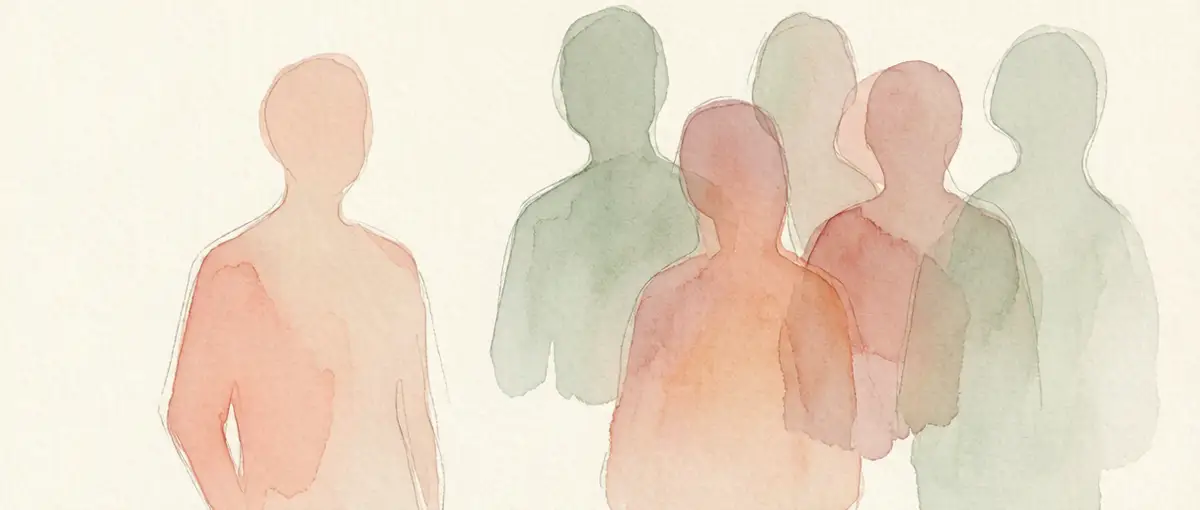
Gu Chen: the distance in a crowd where you don't feel the cold
Gu Chen, in the system of Chinese destiny analysis, is a spiritual marker associated with solitude and keeping to oneself. Traditionally it marks that natural sense of distance some people are simply born with. It is not an insult, calling someone aloof, and it does not mean the person is doomed to a bleak life. It simply points to a very common state: some people simply need — and naturally take — a bit more distance than others. They stand in the middle of a crowd and don't feel cold; they sit alone and don't feel empty.
You probably know someone like this, or you are that someone. At a gathering he's there too, laughing, picking up the thread of conversation — but you know he could step away at any moment, and step away with zero guilt. Not pretending. He genuinely doesn't need to be surrounded. Others fear the quiet; he fears being stuck to. Others drift toward the crowd; he steps half a pace to the edge. That step back isn't rejection — it's room to breathe.
This distance isn't dislike of anyone. Many misread people with a strong Gu Chen as cold. In truth they're considerate toward others; it's just that they always keep a door in their heart that no one enters, and that they themselves often don't enter either. He's present in the noise; when it breaks up he doesn't hold on. You text, he replies; you don't reach out for three days, and he won't panic. To an outsider this rhythm looks thin, but he knows it's steady.
In relationships, what he's worst at is "filling the silence." Two people together, he won't rush to find a topic, hand you a step up, patch the empty space into something lively. He enjoys that empty space — even feels that stretch of not-talking is the most comfortable part of being together. But the person across from him usually can't take it — reads the lull as disdain, reads the silence as distance. For someone with a strong Gu Chen, being able to sit quietly together is in fact the highest closeness.
Not that he doesn't need people. He gets lonely too — only his loneliness is different from others'. Other people's loneliness is "no one's with me"; his is "been with people too long, want to hide." So he doesn't make friends by quantity, but by those few who can each do their own thing, who feel safe without intruding on each other. A crowd's noise tires him; one or two people's light company restores him.
Being alone isn't escape, it's recharging. Many people with a strong Gu Chen don't dislike liveliness — it's just that the recharge after liveliness has to happen in solitude. After a party, others are still wanting more; he's quietly drained his social battery to the warning line. At that point being alone isn't coldness, it's recovery. Don't pull him into a second round right when he wants quiet after the party ends — that's more exhausting than overtime.
That "can leave anytime" looseness is something others envy but can't copy: he never ties any relationship down to himself. A friend marries, he offers blessing; a colleague leaves, he says goodbye; someone he likes walks away, he doesn't cling. Not that he doesn't care — he accepted early that "people coming and going" is the norm. This looseness sometimes makes those who care about him feel insecure, but from another angle, he's never pressed on anyone either.
This distance often shows up very early. Other kids clustered to play; he might build blocks alone on the side, watch ants move house — not unhappy, just that satisfaction of "being present to himself" comes more directly. Adults worry "this child is too solitary," but when he's alone he isn't empty. Later, grown up, this rhythm doesn't change — only the adult world prefers to treat "loving solitude" as a deviation to be corrected, and he slowly learns not to explain.
His friends have to be "light." The kind you can ask out anytime, drop anytime, who don't interrogate "where'd you go these past two days" — those feel best to him. The binding feel of heavy relationships presses on him: daily check-in greetings, must-reply-in-seconds, emotions must sync — what's intimacy to others is a slow suffocation to him. So he doesn't have many friends, but each one can survive "not contacting for long and still being fine."
He's not in any circle, yet not left out either. At a party he sits; anyone can exchange a few words with him, then he returns to his corner, like a stone the water flows around — present, yet not swept into any circle. Others see him as solitary; he feels he's just right. That "not assigned to any team" state is the most comfortable stance for someone with a strong Gu Chen: he can see everyone, yet needn't belong to anyone.
When a relationship ends, he won't cling much either. Not that he doesn't care — he feels "if someone wants to leave, let them" is more dignified than "clutching them so they can't go." But he turns the page slowly — surface calm as still water, inside maybe taking a long time to settle. So don't be fooled by his surface ease, thinking he really doesn't hurt at all. He just takes the hurt into that room no one enters, and lets it slowly dissolve.
The hardest part is not treating this solitude as a sickness. People around always like to advise: "you're too much of a homebody" "go socialize more" "how can you be alone." But shove him into a crowd by force and he'll only want to flee more. What he needs is permission not to be lively — not that no one loves him, but that love's form has to leave blank space. Don't rush him back to the group, don't be embarrassed for him; he's fine sitting on the edge by himself.
He can be warm too, just warm with choice. Don't think people with a strong Gu Chen are cold. Truly close, truly trusted — his consideration and care are no less than anyone's. Only that warmth he gives with choice, not to casual acquaintances. You're in trouble, he may not say pretty words, but will quietly lend a hand; you're drowning in a crowd, he may not pull you out, but will leave a quiet exit waiting for you. This warmth doesn't make noise, but lasts. Many only understand later: that "not-clingy" closeness of his is what makes people feel safest.
A weekend alone is a vacation he gives himself. For someone with a strong Gu Chen, a weekend undisturbed by anyone is the best thing. No need to reply to group messages, no need to show up, no need to explain whereabouts — a whole day arranged by himself. That luxury of "all the time is my own" is more real than any reward. He's not without plans, it's just his plans have no one else in them. You treat loneliness as a lack; he takes that freedom as a prize.
He's not without need for response, just needs a slower response. People with a strong Gu Chen aren't stone; they care how others see them too. Only he's used to pressing that care down very slowly — whether you reply, whether you ask him out, he won't overthink immediately, but over time he'll quietly pull the distance a bit further. So being with him, no need to reply in seconds, but "reply steadily": not contacting often is fine, but when you do contact, you're really there. That rhythm settles him more than daily heat.
In closing
Gu Chen, in the end, is a naturally left-open gap when getting along with people. It's not coldness, not pity — just that some people are born needing that distance not be filled. If someone like this is by you, don't keep trying to pull them into the circle; if you're such a person, don't blame yourself for "not fitting in." Standing at the edge and not feeling cold is proof a person has settled themselves well. In the end, the distance he needs was never about shutting people out a thousand miles — it's the room to stay in his life comfortably. That not-too-cold, not-too-far way of being together is precisely the longest companionship he can give.
Written and reviewed by DustEcho Editorial for self-reflection and cultural inquiry—not counseling, medical advice, or a clinical diagnosis.
Not sure where to begin?