Dependent Origination: You Were Never an Island
DustEcho Editorial
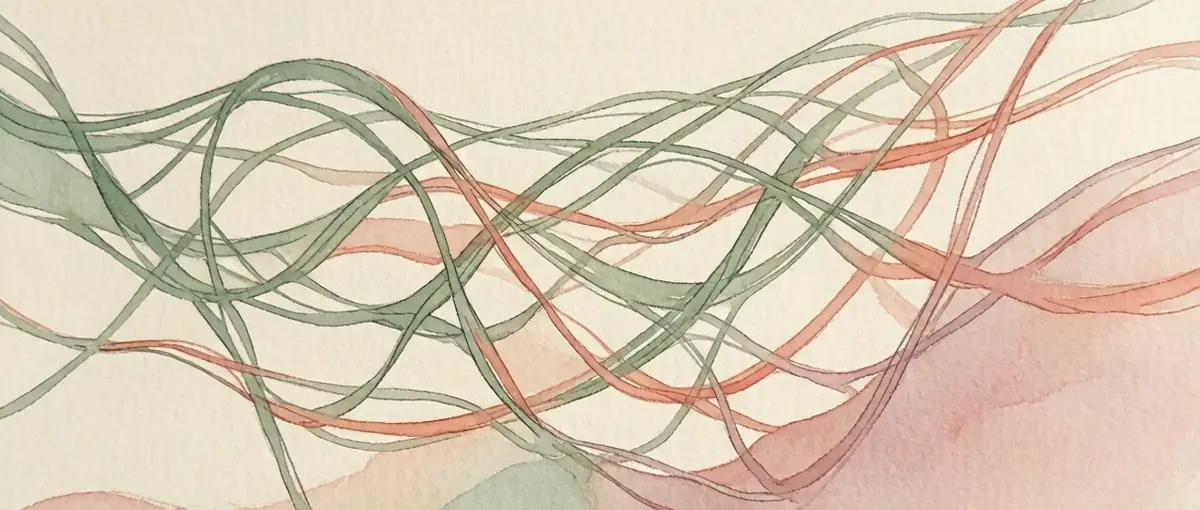
A cup of tea arrives in your hands and you think you made it. But trace the line backward and you find the person who planted the bush, the hands that picked the leaves, the one who dried and rolled them, the truck that carried them across the country to your city, the electricity that boiled your water, and the quiet part of you that was willing to sit down and actually drink. Pull out any single link and this cup would not exist in the shape it does now. That is what the Buddhist teaching of dependent origination is pointing at: everything appears because conditions converged. Nothing stands apart from everything else, alone and self-enclosed.
What You Call "Me" Is Really a Pile of Conditions
We say "I" almost without thinking. I succeeded. I messed up. I decided. But the thing we name "I" is itself a meeting of conditions: your genes, the household you grew up in, the people you bumped into, the books you happened to read, the state of your body this very moment. Peel those layers back one by one and the isolated, purely-your-own self slowly dissolves. This is not a denial that you exist. It is the quieter truth that you were never an island. Every choice you make has a thousand hands behind it, pushing.
When Bad Things Happen, Don't Blame Only Yourself
Dependent origination is not mysticism. It is simply putting on a different pair of glasses. When something goes wrong, the first reflex is usually to blame myself. But the teaching says that event, too, was a pile of conditions that happened to line up — the timing, the tone someone used, the mood the other person was in that day, the sleep-deprived brain you were arguing with. You were one of the threads, but not the only one. See the whole web and you stop loading the entire weight of responsibility onto your own shoulders, and you stop flaying yourself until you are worth nothing.
When Good Things Come, Don't Take All the Credit
And when good things arrive, don't thank only yourself either. You worked hard — true — but there was also luck, the help of other people, the luck of timing. Dependent origination makes a person humble and, at the same time, steady: you are not carried by your own brilliance alone, and not by good fortune alone either. The conditions and you completed that thing together. Grab all the credit and the next step turns slippery with pride. Push all the credit onto fate and the next step turns limp with resignation. See the web clearly and you stand firm.
A Relationship Is a Meeting of Conditions
A relationship is a meeting of conditions, not a binding contract. Two people drew close because countless conditions overlapped: the same city, the same circle, the same frequency. The day those conditions shift and the closeness fades, it is not that someone betrayed someone. A thread in the web simply loosened. Dependent origination asks for a little less clinging to coming and going, and a little more cherishing while they are here — because you know that meeting at all was already a grace of many conditions. It arrived by luck; it can leave in calm. Nothing lost.
Change One Condition, and the Whole Situation Shifts
Change one condition and the whole situation moves. This is the most practical corner of the teaching. When you feel stuck, it is not necessarily that "you are no good." Some condition may simply be jammed: change the environment, change the company, change the rhythm, and the web reweaves itself. You are not asked to overturn yourself. You are asked to adjust the conditions that can be moved. Many deadlocks are not about you at all. A thread is just caught in the wrong place, and a small shift brings it back to life.
Even Your Enemy Deserves Less Certainty
Dependent origination also softens the absolute way we treat enemies. The person who seems to oppose you at every turn was also shaped by a pile of conditions: their history, their fears, their tiredness that particular day. Seeing this layer, you may not forgive them — and you do not have to — but at least you stop casting them as pure evil. The knot inside you loosens a little. You are not being asked to make peace with the enemy. You are being asked not to let hatred nail you to the same spot forever.
When You're Anxious, Find the Missing Thread
Modern people love the anxiety of "I am falling behind." But falling behind is also a pile of conditions: you started late, you had fewer resources, you switched tracks in the middle. Dependent origination lets you take the anxiety apart and notice it is not that you are incapable, only that some conditions have not yet converged. Then you can quietly go and gather those conditions, instead of collapsing into self-denial. Most anxiety is simply reading the wrong scale — mistaking one unconnected thread for your entire life.
The One Thing Worth Looking at Again Today
Here is the one thing worth looking at again today: pick one event you recently laid at the door of "me" or "him," and in your mind pull it apart into a string of conditions. You will find yourself lighter — not because you dodged responsibility, but because you finally saw the thing as it actually is, instead of glaring at a single point and wrestling with it. See the web and you know where to put your hands, instead of punching at empty air.
Failure, Too, Is Conditions That Didn't Line Up
When you botch something, the first reflex is often "I am just not capable." But the teaching says that was only conditions failing to converge: your information was incomplete, your state was off, you ran into a rare combination. Tallying all of it onto "me" is neither fair nor useful. See which threads were missing and go补 them next time — far more real than lying in the "I can't do anything" hole. Failure is not a verdict. It is a reminder of how many loops the web is still short of.
The Fact That You Are Not an Island
The person who always feels like they are fighting alone has simply forgotten how many threads run through them. The bite of food you ate connects you to the farmer and the soil. The truth you understand connects you to the people who wrote the books. The hard thing you survived connects you to whoever once lent you a hand. Dependent origination does not dismantle you. It shows you that you have always been held. Knowing this, loneliness grows lighter, and a kindness toward others becomes easier to feel.
Loosen the Thread You're Tugging Against
A lot of suffering comes from gripping tight the thread that says "why does it have to be me." Dependent origination shows you that what happened to you was also countless conditions happening to converge at this point. It was not aimed at you. The web simply wove itself that way. Loosen the thread you were tugging against and you can spend your strength on the conditions you can actually adjust, instead of swinging at fate with empty fists. Accepting "it just happened to land here" turns out to be its own kind of freedom.
See the Web, and Arrogance Softens
When you know you are held, it becomes easier to bend. You no longer feel it is all your own doing, and you stop treating other people's help as charity. Dependent origination makes a person steady and humble at once: what you received had a share of luck; what you achieved had a share of others' work. This clarity is far lighter than the lonely pride of pretending to hold yourself up, and it makes you more willing both to receive a hand and to offer one.
Changing Conditions Beats Changing Fate
People are always asking how to change their fate. The answer from dependent origination is plain: stop staring at that empty word "fate" and go adjust the concrete conditions. Want a healthier body — adjust the threads of sleep and movement. Want better relationships — adjust the threads of how you spend time and how you talk. Fate is the shape of the web; conditions are the knots in it. Untie one knot and the web loosens by an inch. That is more real than praying to gods, and more useful than sighing at the ceiling.
What does dependent origination mean?
Dependent origination is the Buddhist idea that events, identities, and suffering arise through many conditions rather than from one isolated cause. It can soften blame without erasing responsibility: changing one condition can change what becomes possible next.
How can seeing the web help when I feel anxious or guilty?
Name the conditions around the problem—sleep, pressure, history, relationships, resources—and choose one condition you can influence. Understanding context is not making excuses; it is finding a lever that is more useful than self-punishment.
Want to understand why seeing yourself as an island feels so heavy?
If you carry every outcome as proof of your individual worth, gentle self-exploration can help you see the web without giving up your agency.
Dependent Origination Makes Apologies Easier
Once you know everything is a convergence of conditions, you stop so easily dumping all the fault on the other person — and you also stop so easily booking all the debt under your own name. When two people fight, most of the time their separate conditions simply collided. No one was born to harm the other. See that layer and the words "I had a part in this too" become sayable, and the relationship recovers faster than when pride is the only thing left standing. Admitting the collision is not the same as surrendering. It leaves the door open for things to soften.
In the end, dependent origination does not ask you to erase yourself. It asks you to see that you have always lived inside relationship. You are not an island. You are one thread in a vast web, connected to countless things. And honestly, that is rather warm.
Keep reading: Cause and Effect: The Echo You Leave Behind · Bianyi: What You Thought Was Nailed Down Has Been Moving All Along · Buyi: When Everything Turns on You, Something Ought to Stay
Written and reviewed by DustEcho Editorial for self-reflection and cultural inquiry—not counseling, medical advice, or a clinical diagnosis.
Not sure where to begin?