Cause and Effect: The Echo You Leave Behind
DustEcho Editorial
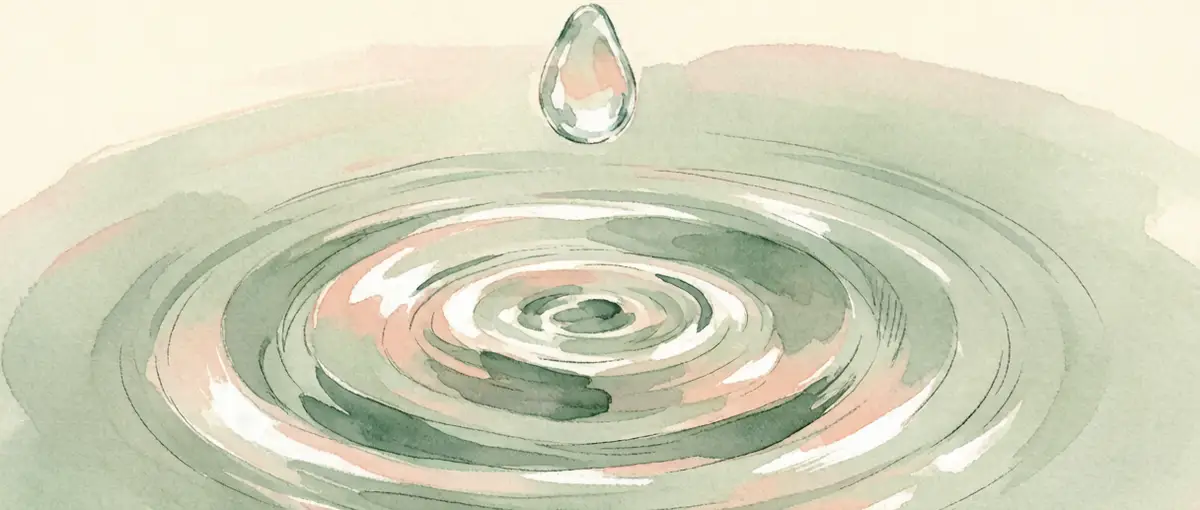
One year I casually promised to help an acquaintance polish his résumé, and spent a whole evening on it. I expected nothing back and forgot about it the next day. Half a year later I was stuck in an unfamiliar field, and it happened he knew it well — he pulled me through without a second word. That experience was the first time I brought 因果, cause and effect, out of the temple and back into daily life. It isn't the late-arriving retribution of a TV drama; it's a plain chain: every action you send out will, at some corner, circle back to you.
What does cause and effect mean in everyday life?
In this Buddhist context, cause and effect is not cosmic punishment or a fixed script. It is a way to notice how repeated words, choices, and habits leave traces in your relationships and future options. Explore the idea gently if you want to change a pattern without turning your past into a sentence.
How can I change the cause I am planting now?
Choose one small action that changes the next link in the chain: a clearer boundary, a repair, a promise kept, or a habit that supports tomorrow. Results may take time, so focus on the part you can actually do.
It's not a threat from the temple
In Chinese, 因果 is often reduced to "good is repaid with good, evil with evil," which sounds like a threat, or like bookkeeping. The original Buddhist meaning is far plainer. The cause (因) is the action you plant this moment — that sentence, that thought that rises in your mind. The effect (果) is what grows from it, riding on conditions and time. It isn't heaven keeping accounts; it's that your action itself carries weight, and leaves a trace in your relationships and your life. Everything you do leaves an echo behind you — it's just that sometimes the echo travels a little farther before it returns.
Between cause and effect, there is time
What's easy to miss is that between cause and effect there is time, and there are conditions. The word of encouragement you toss off today may not take effect tomorrow, but it plants a seed in the other person's heart; someday when they're down, that sentence will surface on its own and hold them up. Likewise, the promise you brush off today to save yourself trouble seems fine in the short term, yet the membrane of trust has grown a little thinner — and the half-second of hesitation next time you need them is the effect. Cause and effect never stand you up; they simply keep their own clock.
Every word you speak is a seed
Every word out of our mouths is, in truth, a seed. A word of praise plants the cause of the other person wanting to come near you; a cutting word plants the cause of them quietly building a shell. I'm not saying you must be a sage — only that you needn't mistake thoughtless speech for honesty. You think it's over once you've said it, but the sentence has already left you and gone to live in someone else's memory. Words, once spoken, can't be taken back; that is cause and effect in its most everyday form.
It's not fate, it's a theory of action
Some people treat 因果 as fate: when something bad arrives, it must be a sin from a past life. This is exactly the misunderstanding Buddhism most opposes. If everything were a predetermined debt, what would be the point of practice? The real view of cause and effect is the active kind: the cause you plant now is deciding the effect of the future. The past can't be changed, but the hands of this moment are yours. It isn't fatalism; it's a theory of action. Every small choice you make today is a vote cast for the self of tomorrow.
Change the cause, and the effect will turn
So change along the line of the cause, and the effect will turn. A relationship has gone cold — not sit waiting for the bond to run out, but plant a new cause: a message of care, a moment of real listening. Your state is poor — not resign yourself to "this is just who I am," but plant a new cause: sleep early once, step outside for a walk. The most encouraging thing about cause and effect is that it hands the future back to you, instead of locking it in the drawer of the past. You are not a victim; you are a gardener.
Why "the wicked get their due" is so often doubted
The most easily misread half is the "evil is repaid with evil" part. In life, many mean people thrive just the same, and many kind people still take losses — so some grow angry: cause and effect must be fake. But cause and effect is not an instant scale; it is a long river. What you plant may not bear fruit in this lifetime, but it is truly flowing. Not seeing the return doesn't mean there is no return. Treating it as instant reward and punishment actually underestimates it. The most short-sighted view of cause and effect is the one most likely to disappoint.
Habit is also a cause
There's a kind of cause that hides most deeply: the small actions you repeat every day. Scrolling on your phone until past midnight plants the cause of tomorrow's fogginess; the cold face you've grown used to showing your family plants the cause of a home that grows colder; running from every problem plants the cause of problems piling ever higher. They aren't as visible as big events, yet like a foundation they hold up the direction your life takes. When you complain that life is unfair, you often have to look first at what kind of cause you plant every single day. Change begins with the smallest habit.
The chain of cause and effect at work
This chain is clearest at work. Every time you deliver on time, you plant the cause that others will dare hand you important things; every time you pass the buck, you plant the cause that next time no one will want to pair with you. It isn't the boss watching you — it's your behavior keeping accounts, entry by entry, in your colleagues' hearts. So-called reputation is nothing but the cause you planted in the past, bearing fruit today. You needn't please anyone; only be honest with every move you make.
The smallest seed you can plant today
The seed you can plant today is often the smallest one. Say thanks to the neighbor who fetched your takeout; spare your colleague who erred one harsh word; replace "I can't" with "I'll try." Seen alone these small things carry no weight, but strung together they become the way you get along with the world — and thus what kind of response you'll receive in return. Cause and effect doesn't mind small deeds; it only minds that you don't act.
A smile travels farther than you think
The kindness you hand out often travels farther than you imagine. The smile you gave the convenience-store clerk today, he may carry that bit of good mood to the next customer. Cause and effect doesn't only count the big things; tiny warmth too travels along invisible threads to places you can't reach. You needn't chase after where it went — just keep handing it out.
Don't use cause and effect to frighten yourself
Some turn 因果 into a whip: make the slightest mistake and they feel they're due for punishment. This too turns Buddhism into a threat. Real cause and effect is open — this moment you can plant a new cause and steer the old direction around. It is not a judge; it is a teacher. You change, and the effect changes with you; you needn't stand punished, carrying past mistakes forever.
Cause and effect are in no hurry
A seed needs time to break soil, and cause and effect needs time to show itself. The cause you plant today may bear fruit only half a year later, at some opening. Don't stop your hand just because you see no return in the short term, and don't think you've escaped just because you've tasted no bitterness yet. It keeps its own rhythm; all you must do is not cut off the supply. Steady good causes are more reliable than a one-time feat.
You are also someone else's cause
Don't only watch the fruit you receive and forget you are also someone else's cause. The word of guidance you give that newcomer may plant the cause that he'll be willing to guide the next newcomer. Cause and effect is a two-way river; you are both downstream and upstream. Understand this, and every kindness you give gains weight — not random good will, but a flame someone will pass on. The warmth you send out never truly disappears; it only curves to a corner you can't see and takes root elsewhere.
Cause and effect play no favorites
The cause you plant takes effect on everyone — including yourself. Be good to others, and your own mind brightens first; be harsh to others, and your own heart cools first. The fairest thing about cause and effect is that it acts first on the one who plants the cause. The first to receive what you send out is yourself. So whether you treat others with compassion or with meanness, the first to be changed is, in truth, your own face.
In the end, 因果 isn't there to make you tremble in fear of retribution. It's a gentle reminder: you are the gardener of your own life, and you always hold seeds in your hand. What you plant, and what you don't, matters more than calculating the day it will bloom.
Keep reading: Dependent Origination: You Were Never an Island · Bianyi: What You Thought Was Nailed Down Has Been Moving All Along · Buyi: When Everything Turns on You, Something Ought to Stay
Written and reviewed by DustEcho Editorial for self-reflection and cultural inquiry—not counseling, medical advice, or a clinical diagnosis.
Not sure where to begin?